Tuesday, March 5, 2019

The Gingerbread Man

Once upon a time, an old woman and her husband lived alone in a little old house. The old woman and the old man were hungry. So, the old woman decided to bake a gingerbread man. 

She carefully mixed the batter, rolled out the dough and cut out a very nice gingerbread man. She gave him currants for eyes and cherries for buttons. Then she put him in the oven to bake. 


In the meantime, she begun to hum soundly. When he was fully baked, she slowly opened the oven door. What a fine looking gingerbread man he was!

Up jumped the gingerbread man and he ran out of the door saying, "Run, run, as you can! you can't catch me! I'm the Gingerbread Man!"

The old woman ran after him but she could not catch him. "Stop" the old woman yelled but the gingerbread man did not look back. 

The gingerbread man ran on saying, "Run, run, as you can! you can't catch me! I'm the Gingerbread Man!" 

The gingerbread man ran into the garden and passed the old man. "Stop!" the old man called out, "I want to eat you." But the gingerbread man ran even faster, chanting, "Run, run, as you can! you can't catch me! I'm the Gingerbread Man!"


 The gingerbread man ran through the yard and passed a cow. "Stop! Stop!little man," called the hungry cow, "I want to eat you." Again., the gingerbread man ran too fast. 

A little further on, he met a horse. "Stop! little man," called the hungry horse,"I want to eat you." But the gingerbread man ran even faster.
The gingerbread man passed three farmers in the field. They shouted, "Stop! Stop! we are hungry. We want to eat you." But he ran even faster, saying, "Run, run, as you can! you can't catch me! I'm the Gingerbread Man!" The three farmers too joined the chase. 


The gingerbread man laughed and laughed, until he came to a river. "Oh no!" he cried, "They will catch me." A sly fox came out from behind a tree. 

The sly and hungry fox saw the gingerbread man and said, "I can help you cross the river. Jump onto my tail and I will swim across."

"You won't eat me, will you?" said the gingerbread man.
"Of course not," said the fox,
"I just want to help."

The gingerbread man saw the crowd chasing him. He said to the fox, "Hurry up, otherwise animals and people chasing me would catch and eat me up." 

Saying so, he jumped on the fox's tail. Soon they started across the river

Halfway across the river, the fox yelled, "You're too heavy for my tail; jump onto my back." So the gingerbread man jumped onto the fox's back.


Soon, the fox said, "You're too heavy for my back; I am tired. Jump onto my head." So the gingerbread man jumped onto the fox's head.

As soon, as they reached the riverbank, the fox flipped the gingerbread man into the air. The fox opened his mouth and came the sound 'Snap!' That was the end of the gingerbread man.


* The End *


Source: Kids Board Fairy Tale 
 MANOJ PUBLICATONS 
761, Main Road, Burari, Delhi- 110084
website: www.manojpublications.com

Monday, March 4, 2019

Rumpelstiltskin

Once upon a time there was a miller who was poor.
He had a beautiful daughter. Now
the miller had a bad habit of bragging. One day,
the King came on visit. He heard the miller bragging to the people.
"Do you know, I have a daughter who can spin straw into gold!"

The King was surprise to hear this. He called the miller and
said to him, "If your daughter is as skillful as you say, then bring her to my palace
tomorrow. I will put her to a test." The miller was terribly upset but he
couldn't refuse the King. The next morning, the miller and his daughter went to the King's palace.


On reaching the palace, the girl was led to a room that was filled with straw. 
Giving her a spinning wheel, the King said, "Get to work now. 
Spin all this straw into gold or you shall die!" Then he locked the room and left.
The poor miller's daughter sat in one corner and cried. 
She had no idea how to spin the straw into gold.

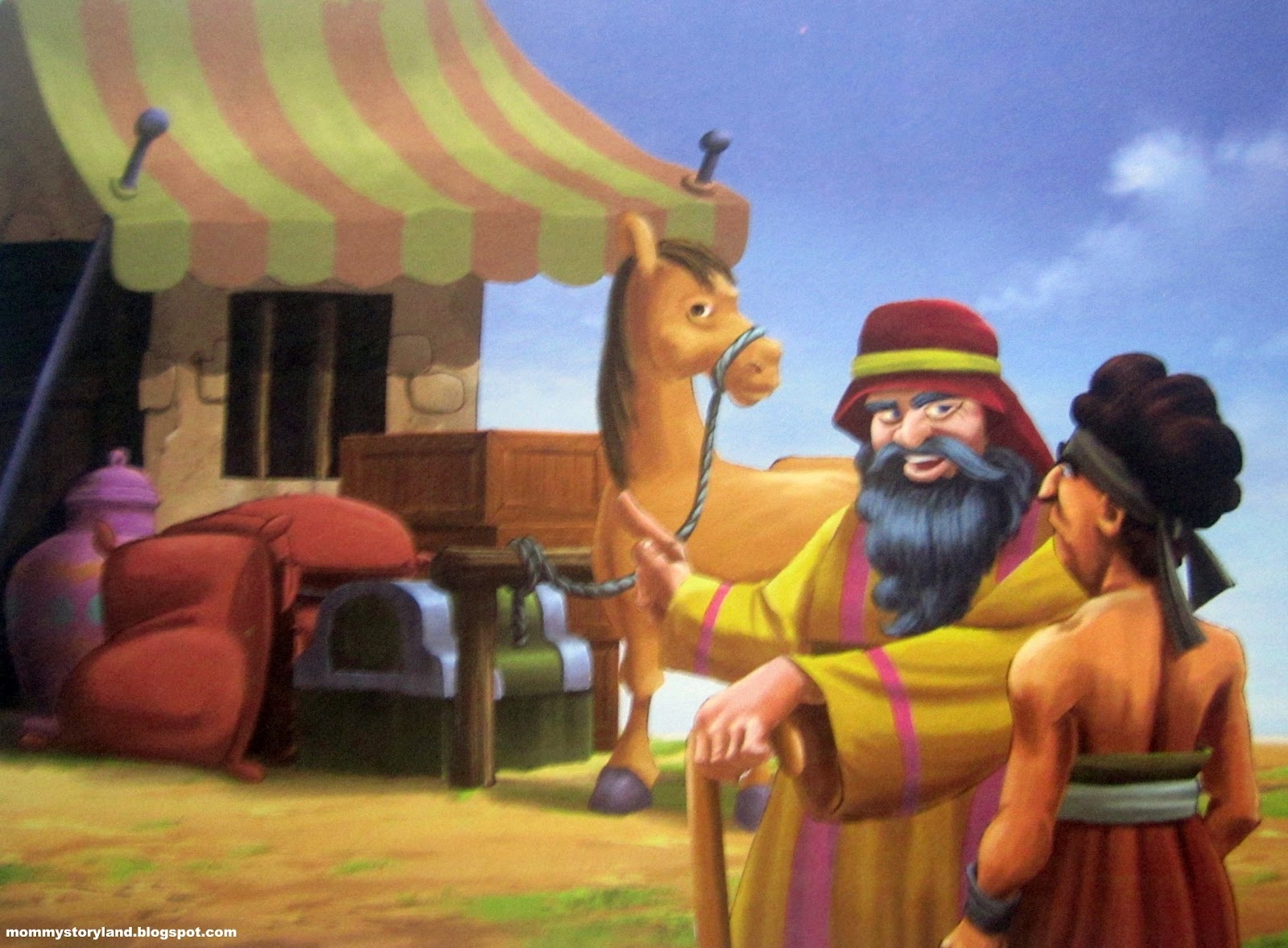
Just the, the door opened. A little man who was strange looking stepped inside and said, "Good evening, sweet lady! Why are you crying?"
"Oh, I am supposed to spin these straws into gold and I do not know how to do it," 
answered the girl, sobbing. 
The little man said, " What will you give me if I spin it for you?" 
"My necklace," said the girl. 


The little man took the necklace, sat down before the spinning wheel and pulled it three times. Instantly, all the straw was spun into gold! The next morning, the King came and when he saw the gold, he was very happy. But instead of being satisfied, he became very greedy.

This time, the king took the miller's daughter to a bigger room filled with more straw. "Spin all these straw if you wish to be alive!" He warned her. The miller's daughter was very sad. She sat in the corner of the room and began to cry. 

Once again, the door opened and the little man appeared. He asked, "What will you gave me if I spin the straw into gold for you?" 

"My ring," answered the girl, amidst her tears.
Once again, the little man took the ring, and spun all the straw into glistening gold. 

The king was happy beyond measure when he saw the gold. But he was not satisfied. He took the miller's daughter to a still larger room filled with straw and said, "Tonight, you must spin this too. If you succeed, you shall become my wife." 


When the girl was alone, the little man returned for the third time. He said, "What will you gave me if I spin the straw this time?"
I have nothing more that to give you," answered the girl, sadly
"Promise me, after you become the Queen, you will give me your first child."

The miller's daughter agreed to his condition having no other alternative. In return, in return the little man once again spun the straw into gold. 
In the morning when the King came and found everything just as he desired, he married her. The miller's beautiful daughter became the Queen. 

Time passed and a year later the miller's daughter gave birth to a beautiful child. She was so happy with her present life that she had forgotten her promise to the little man. But one day, suddenly the little man appeared in her room and said, "Now give me your child as you have promised!" 
The Queen was frightened and offered the little man all wealth of the kingdom instead of the child. But the little man didn't agree to this. 
The Queen began to cry so much that the little man took pity on her and said, "I will give you three days. If you are able to tell my name, then you shall keep your child. 

That night, the Queen kept on thinking of all the names she even heard. Then she sent a messenger into the country to inquire about the little man. When the little man came the next day, she began with Kaspar, Melchior, Balzer. The Queen said all the names she could think of. But after each one the little man said, "That's not my name!"

The second day the Queen sent her messenger to the neighborhood to inquire about the names people had. She recite the most unusual and most curious names to the little man. "Is your name Beastrib? Or Muttoncalf? Or Legstring?"
But he always answered, "That's not my name!"


On the third day the royal messenger returned and said, "Your Highness, I have not found a single new name. But in the forest, I saw a little man jumping and hopping on one leg and singing, "Today I'll bake, tomorrow I"ll brew, Then I'll fetch the Queen's new child, It is good that no one knows, Rumpelstiltskin in my name."

The Queen was overjoyed. Soon afterwards the little man came in and asked, "Your Majesty, tell me my name." 
"Is your name Conrad?"
"No, not at all!"
"Is your name Heinrich?"
"No, not at all!"
"All right, is your name Rumpelstiltskin?"
The little man was shocked at this. 
"Who told you my name? Oh dear, 
What shall I do!" saying this, he ran away into the forest 
never to return.  


 * THE END *


Source : PEGASUS BOOK
(C) B. Jain Publishers (P) Ltd.
Published by Kuldeep Jain for
PEGASUS 
An imprint of 
B. JAIN PUBLISHERS (P) LTD. 
Printed in India by:
J.J. imprints Pvt. Ltd. 


Monday, February 6, 2017

Excitement on Appleby Street


      Joey walked down the Appleby Street. He thought his tooth. It was about to come out.
Joy wanted it to come out so he could wish on it.
He wanted to wish for some gold fish.

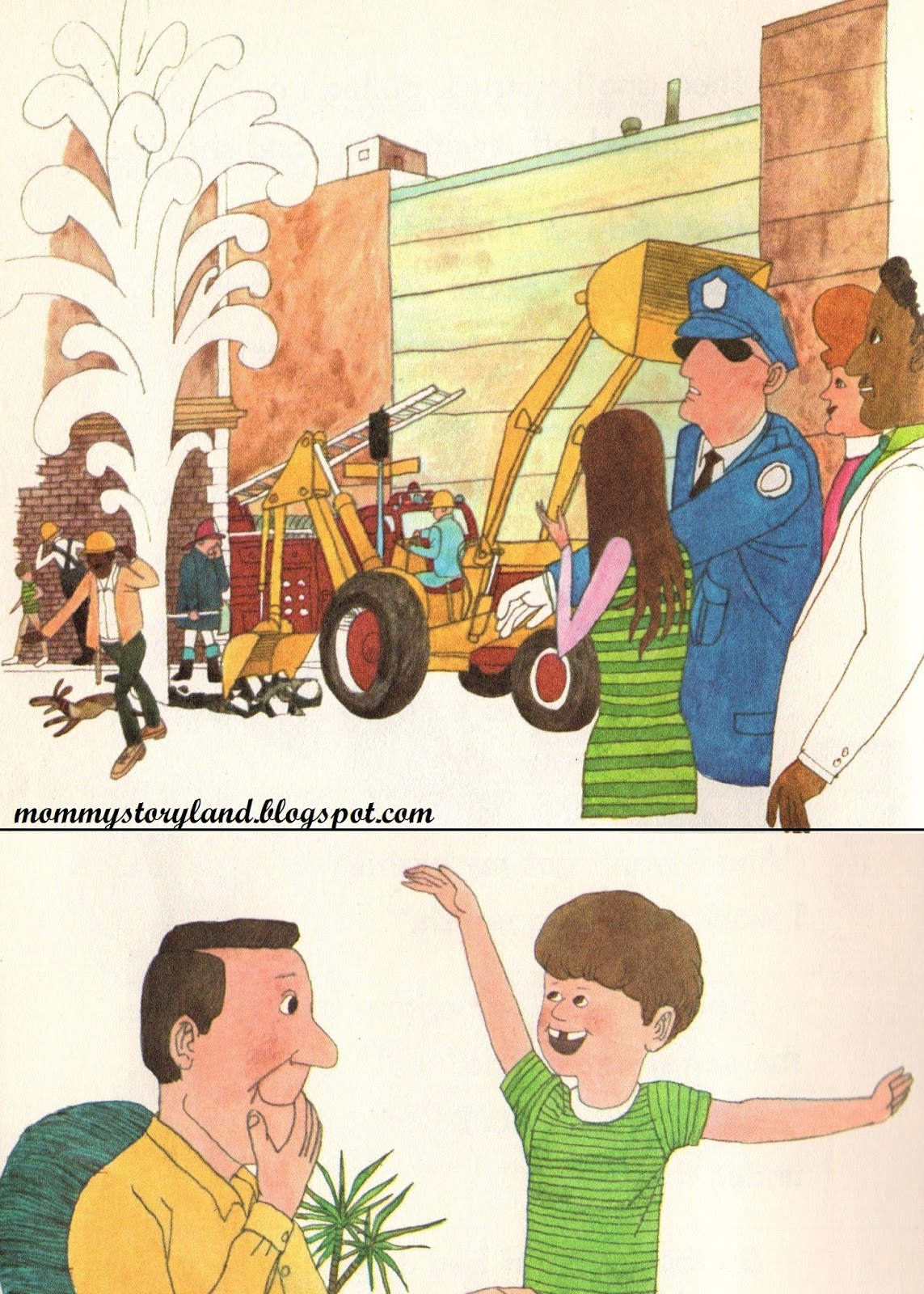
      Just then Joey saw an open manhole.
There was a fence around the hole.
Red flags and a sign were on the fence.
The sign said MEN WORKING.

      Joey looked into the manhole.
Then he sneezed.
His tooth fell out of his mouth.
It fell down into the manhole.
      "My tooth!" cried Joey.
      "I lost my tooth down there!"

       All at once some men inside the manhole started yelling.
"I'll get it," yelled one man.
"Call the police!" cried another man.

      Then a man came out of the manhole. He ran down the street.
"It's just a tooth!" called Joey.
But no one heard him.

       People came out running from all over.
A big fire truck came around the corner.


       Then another truck pulled up. 
Men jumped off it with picks and shovels.

       Joey did not think about his tooth.
All he thought about was the excitement on Appleby Street.

      A road-breaker came next.
It stopped a few feet from the manhole.
It started to make a hole in the street.

        "The water pipe broke!" called a man."Turn off the water!"
Some other men climbed down into the manhole.
And at last the water stopped.

       Joey thought, "This excitement was fun.
But I'll go home now.
I guess the men will bring my tooth to my house later."

Joey went home.
He told his father about his tooth and about all the men looking for it.

       "Oh, Joey!" laughed father.
"The water pipe broke under Appleby Street.
The men were running to help to fix it.
I don't think they were looking for your tooth."

       "The men won't find it!" cried Joey.
"And I won't get my wish! I won't get my gold fish."

      Father said, "sometimes a tooth under the street works fine. Sometimes it works better than a tooth under the pillow!"

      So that night in bed Joey went on his wishing for his goldfish. 

      Morning came.
      Joey woke up and looked around his room. 
Yes, the gold fish were there!
Three tiny gold fish n a little bowl!

       "Dad was right," thought Joey.
       "A tooth under the street works just as well as a tooth under the pillow.
       My gold fish will be as much fun as all the excitement on Appleby Street."

- E N D - 


Wednesday, February 1, 2017

Jimmy's Pocket-Aunt


     "Jimmy," said Grandma Jones.
"I'm busy this morning. You take care of your Aunt Alice."

     Aunt Alice was only three year old. 
Jimmy was five years older than aunt Alice.
He did not like to take care of her.
All his friends laughed at him.
They thought it was funny to have such a little aunt.

     Jimmy took aunt Alice out into the yard. 
He began to read, and aunt Alice played.

     Soon Jimmy heard music coming from the park.
But he did not hear Aunt Alice.
He jumped up and look around,
No Aunt Alice!

     Jimmy ran to the park to look for her.
He could not find her anywhere.
     A policeman named Mr. Lee came along.
     "What's your name?" asked Mr. Lee.
"And what's the matter?"

     Jimmy said, "My name is jimmy Jones. My Aunt Alice is lost."
 "What does she look like?" asked Mr. Lee. "Is she young or old?"

     Jimmy told Mr. Lee what she looked like. But he did not want the policeman to know that she was only three.
     So Jimmy said, "I guess you could say that Aunt Alice is young."
     The policeman and Jimmy went into the park building.
     "Will Jimmy Jones' Aunt Alice come to the park building?" called the policeman.
     
     Mr. Lee called four times.
But Jimmy knew Aunt Alice could not find the park building.
     Mr. Lee said, "Just sit there, Jimmy.
Lost boys are always found in this park."

     "I'm not lost!" Jimmy said."My Aunt Alice is lost!" 
Jimmy thought, "Maybe I should tell him Aunt Alice is only three years old."
Just then a policeman walked in.
He said, "Here's another lost child."
     "That's my aunt Alice!" said Jimmy.

     Mr. Lee said, "What a pretty little aunt! I had a little aunt when I was a boy.
I called her my pocket-aunt. I liked her. All the other boys wanted a pocket-aunt like mine."

     Jimmy thanked the two men.
Then he started off to his grandmother's house with Aunt Alice.

     Jimmy said to himself, "Mr. Lee liked his little aunt.
I like mine, too. Who said aunts have to be big?
No one!
I'm glad I have a pocket-aunt!"


                           E N D


Source: More Power Book 2 Part 1
Reprinted from Stories.
Copyright 1960 by W. L. Jenkins.

Tuesday, January 31, 2017

Beppe and the Statue

An Italian Folk Tale
Retold by Lee Wyndham


    Near the city of Palermo, in Italy, there once lived a widow named Mama Teresa. She had a only son - a foolish one - named Beppe. Of course she loved him, for she was his mother, yet time and again he tried her patience. 
     There was the day when went to market and left him at home with a setting hen. "Keep your eyes on the hen," she told Beppe. "Do not let her get off the nest. If the eggs get cold, the chicks will not hatch and we shall have neither eggs nor chicken to eat."
     "I shall do exactly what you say," Beppe assured her.
     And he did. He sat in front of the hen and stared at her. This the hen did not like. First she clucked uneasily. Then she ruffled her feathers. Finally, with a great squawking and flapping, she rose from the nest and flew over Bepped's head. As he tumbled backward, He grabbed at her tail feathers. The frightened hen flopped out into the yard and soon vanished down the road. 
     "Wicked hen," Bepped shouted after her. "If you will not set on your eggs, I will do it for you."
     And he did. And of course every single egg was squashed. 
     When Mama Teresa returned, she was furious. But when Beppe explained how he had kept his eyes on the hen and all else that had happened, she threw up her hands. "Enough, enough! Tell me no more. Change your clothes and go out to play."
     Some time after this, the widow sent Beppe to market with a basket of choice grapes from her vines. "Be sure to get a fair price for theme," she cautioned. 
     The first man Beppe met in the market has this, that, and the other thing to say about the grapes - and it was all bad. 
     Hearing this complaints, Beppe was so glad to get rid of the grapes that he sold them to the man for practically nothing. When he brought few coins at home, his mother cried out in dismay. "A whole basket of grapes - stolen from under your foolish nose. All that man had to do was open his mouth, and with the first word you agreed that our grapes were worthless." 
     "No, no, Mama. That was not the way at all," answered Beppe. "The man said the grapes were worthless a great many time." 
     Mama Teresa smacked Beppe soundly, and then she was sorry and kissed him, for he had no sense and could not help being foolish.
   Still, she could not allow him to play all day. One morning she said, "Beppe, here is a piece of pine linen I have maid that should bring at least five pieces of silver. Go into Palermo and find a buyer for it. And this time do not listen to anyone who tries to talk your head off."
     "That I won't," Beppe promised.
     In the bustling city Beppe pushed his way through the crowds, shouting, "Fine linen for sale!"
     Presently a man stopped hi. "My wife would like to see that piece of cloth," he said. "Go to--"
     "Stop!" Beppe cried. "Do not think that you can take my head off ," and he hurried away.
     Next a lady sid, "What do you want for this fine cloth? 
     "Never you mind," Beppe told her rudely. "I'll not let you talk me out of it either. My mother warned me against people like you." 
     Well please with him self, Beppe turned away every buyer who so much as uttered a word. At the end of the day the cloth was unsold, and Beppe was weary of tramping up and down the cobbled streets. 
     Dusk had fallen when he came to courtyard with a stone bench and a pale-faced man, dressed all in white, standing near it. 
     "May I sit here and rest, sir?" Beppe ask the man. The man did not speak, but Beppe thought that he nodded. "Thank you," Beppe said and sank down gratefully. The man did not go away, so Beppe help up the linen for him to see. "It is very fine cloth," he said, "made by my mother. Would you care to buy it?"
     Still the gentleman in white said nothing.
     Beppe's heart rose. He was one who would not talk him into a bad bargain. "I will sell it to you for five silver pieces," he said, and again thought the gentleman nodded. Beppe jumped up from the bench, draped the linen over the arms of the gentleman, and wait to be paid.
     "Five silver pieces, sir," Beppe reminded him. There was no response. "My money," Bepped said loudly. The man said nothing. "If will not pay, I will take back my cloth." Beep gave the linen a tug. It caught on the man's finger and started to rip.  
     "See what you have done!" Beppe yelled. "Pay up or give me the cloth at once!"
     Still the man said nothing and held on the linen. Beppe snatched a stick from the ground. "Let go of my linen," he shouted, "or I shall make you let go!" and he gave a man a whack on the arm with the stick.


     CRRA-AAACK! The man's arm fell off and shattered into a thousand white pieces.
     "Ai!" Bepped covered his eyes and peered through his fingers. The white gentleman stood as before, except that now he had no arms. Nor did he show any signs of pain. Beppe took a step closer to him - and discovered his secret. 
     "Fie on you for deceiving me.You are not a man but a plaster statue," Beppe exclaimed "I'm glad I've got even with you, for now you have no arms with which to play sticks." 
    At that moment a widow was flung open at the back of the courtyard, and a woman called out, "Who is that near my statue?"
     "It is I," shouted Beppe. "Your wicked statue tried to rob-"
     "A robber!" the woman screamed. "Help! Police!"
     "You don't understand!" Beppe tried to outshout her. It was no use. The woman kept screeching for the police.
     The police might not understand either. Beppe scooped up his linen and took his heels.
     As he slid around the corner, Beppe came to a church and slipped inside. He was dreadfully tired. So he climbed up on a marble ledge, wrapped himself in the white linen, and fell asleep. 
     Hushed voices and the click on metal awakened him. In the dim light of the candle, Bepped saw two men crouched over a pile of coins that they were dividing between them. 
     "This was a good night's work," said one to the other. "One for you --and one for me. One for you --one for me." Clink, clink.
     Beppe rubbed his eyes and yawned.
     "What was that?" one of them asked.
    

     Beppe sat up on his marble --only it was not a ledge at all but the marble tom of someone long dead. He yawned again and stretched his arms, spreading wide the white linen cloth as he did so. "It is time to rise?" they yelled, and rushed out of the church. 
     "Wait! Wait!" Beppe shouted after them. "I'm no ghost!" 
     But they were gone-- and there was all that money glittering in the light of the candle. Beppe gathered the coins into the line cloth. It was no longer so fine and white, but that could not be helped. Beppe shrugged as he tied up the corners.
     "I might as well take this money home," he said. "My mama will know what to do with it." And he hoisted the heavy bundle onto his back. 


     Mama Teresa saw him coming and flew to the door.
"Beppe! Where have you?" She clasped him to her tightly, and tears poured from her eyes. When she realized that he was safe and unharmed, she pushed him from her and saw the linen cloth tied in a dirty bundle. 
     "Well, it happened this way," Beppe said, and he told her the story from the beginning. By the time he got to the part about whacking the statue, his mama was pale with fright. 
     "The police! Are they after you?" she asked.
     "No," Beppe said, and told her about hiding in the church and about the men who mistook him for a ghost. "I tried to tell them I was no ghost, but they ran away. So I gathered up the money and brought it with me --and here it is." Beppe untied the linen so she could see the pile of gold and silver coins.
     His mother gasped. Then she swooped up the four corner of the cloth and tied the money once more in a bundle. "Come with me," she commanded and dragged Beppe out the door with her. "We are going straight to the police with this. Even though the thieves left this money behind, it does not belong to us. The police will know what to do with it. And we'll see what we can do about the statue. Ai, ai, ai, Beppe. What a lot of trouble you bring upon my head."
     But as it happened, this time it was not trouble. For the money Mama Teresa turned over to the police chief was exactly the amount stolen from a merchant traveling through the city of Palermo. The merchant was so grateful to see his gold and silver again, the he gave Mama Teresa and Beppe a handsome reward. Part of this they used to pay for the repair of the statue Beppe had broken. And with the rest they were able to live comfortably for many months. 


END


Source: CRICKET the magazine for children
Volume 3 Number 5
Copyright January 1976

Published by: Open Court Publishing Company
Pictures by Fritz Wegner
copyright 1976 by Lee Wyndham

Tuesday, January 24, 2017

King Richard & His Five Daughters

by Esther Vlietinck


  Long ago, when there were still many kingdoms and dukedoms and earldoms in the world, there was a king who lived in an old castle in the middle of a wild and mountainous country. His name was King Richard, and he was not a happy man. His queen had died young, and he was left to took after their five daughters alone. Fate had not given him son, and this was another great sorrow for him.
   
     King Richard knew nothing about raising children, so when his daughters were old enough to leave the nursery, he sent for his sister to teach the five girls to behave as princesses should. Aunt Michtilde was forbidding old lady; she was very stiff and very, very formal. She showed the girls how to curtsy, how to nod, and how to use their fans properly. She instructed them to say, "Yes, Your Majesty," and "No, Your Majesty," in a submissive voice, and -most important -to keep quite at the dinner table, a very difficult thing indeed. The girls were allowed to dine with their father only on Sundays, for he was a very busy king. And even then Aunt Michtilde surveyed their manners with an eagle eye.


     The youngest daughter, however, was excluded from this strict training and from the dinner ceremony. Her name was Rosalinda, and aunt Michtilde found her a most stubborn and disobedient child - she simply would not behave. And so she was entrusted to the care of an old nurse, who spoiled her quite dreadfully.
     Rosalinda, who called herself Linda because she found her name much too long, spent her days running through the large gardens and exploring the rooms of the castle. She spied on the aristocratic guest who visited her father, and then made the cooks and maids scream with laughter at her droll imitations. When nobody was looking, she slid down the ornamental banisters that lined the staircase -from the very top if the turret to the very bottom of the big marble entrance hall. Oh, it was glorious fun.

     But Linda always took great care to stay out of King Richard's sight. Long ago her nurse had told her that the king was angry because she was a girl. He had hoped so much for the fifth child to be a little prince, that he wanted nothing to do with yet anther daughter.  

     King Richard saw his youngest child so seldom that, in time, he almost believed he had but four daughters. For were quite enough, he thought. The search for acceptable suitors was an overwhelming task for a busy, unhappy king.
     When the eldest girl came of age, the king gave a ball in their honor. He hoped to have at least one of his daughters married by the end of the year. But four years and four balls went by, and not one candidate had come forward to woo one of his four daughters. What could be wrong? The princesses all had candidate, regular features. For each ball they were attired in silk and brocade, and their thick braids -coiled around their heads - were decorated with glittering jewels. What was lacking?
   

     Every year Linda watched the festivities through a secret little window. But instead showing compassion for her neglected sisters, she laughed and made fun of theme. "You are much too stiff and much too formal!" she said. "You never even smile." And she would laugh again and imitate theri wooden expressions and their proper curtsies.
     Another year passed, and another ball was to be held. Linda had grown tall and lanky; she was sixteen now, and she was still full of mischief. One week before the dance she told her old nurse of a plan she had devised. She coaxed and begged for assistance, and although her nurse was horrified at first, she let Linda have her way, as usual.


     First she made Linda a velvet suit, just perfect for a young gentleman. Then she cut off Linda's unruly braids and snipped and trimmed until the hair was cut in the latest man's fashion. Linda added to the costume a green felt hat with feathers, s flowing cape, a glittering sword. Then she practiced in front of a large mirror until she could sit and stand, bow and dance like the most elegant of the young gentlemen she had observed. She capered about for hours, enjoying herself hugely and bringng teras of laughter to her nurse's eyes.


     On the night of the ball, the dancing had just begun when a new arrival was announced. The Prince of Livonia!
Livonia? No one had ever heard of such a place. People craned their necklace to see. The prince was a handsome young man, self-assured, proud, and a bit arrogant; he wore a small mask over his eyes. A mystery! At last, something to break a monotony of this tiresome ball.
     The prince dance first with the eldest daughter Miranda. He was visibly courting her, but to the curious guest it seemed a most unusual conversation. The princess laughed at everything he whispered in her ear! Then the prince danced with each of the other three princesses -with Tatiana, with Elfrieda, with Doarda -and each time with the same result: he made them laugh out loud. Though they tried hard to smoother their giggles and now and then looked stealthily to see if their father and aunt were angry, they could not sop their unseemly behavior.
     The other young gentlemen in the hall, who had been thoroughly bored with the formal ball and the dull princesses, begun to wonder whether the king's daughters were as serious as they looked. In five years they had not been able to win even one small smile from the princesses, but this upstart from Livonia had succeeded at once! What did that strange fellow whisper into their ears? One after the other they jealously asked for a privilege of a dance.
     From his throne King Richard watched the proceedings with growing amazement. Never had he seen his daughter s so animated, so lively, so . . . noisy. Aunt Michtilde choked with indignation and had to be carried away, but the king found - to his great surprise -that he was enjoying himself immensely. But when in heaven's name was causing all this merriment?
     The dancers wanted to know, too, but each time they asked their partners, the princesses could only giggle, and blush, and stumble. The young en had to hold them closer for fear they might fall. Never before had such a spectacle been in the palace.
     The Prince from Livonia still danced -now with the on, now with another princess -and after each dance the gaiety rose higher, till at last everybody had to join n the laughter. And without really knowing why, the people became so merry, and the dancing so lively, that not four but eight young men fell in love with the four princesses. Two suitors for each daughter! Another dilemma. king Richard rubbed his beard thoughtfully.
    But the Prince of Livonia had a suggestion, " Your Majesty," he said, bowing very low, "allow all the suitors to visit your court; then let the princesses decide for themselves."
     "A wise decision," agreed the king. "You are a very clever young man." There was cheering and singing from the guests. "One more thing I should very like much to know," continued the king. "What did you say that made my daughters so merry? I've never known them to be anything but serious."
     To everyone's astonishment, the Prince of Livonia climbed the few steps up to the throne and whispered something in King Richard's ear. The king's face was indeed a picture to be hold. First he opened his eyes wide in surprise, then he grinned from ear to ear, and then he laughed until his royal belly shook so much that he had to hold it fast with both hands. This sight was so ridiculous, that the whole company burst into laughter, too. Dancing started all over again and only stopped in the early hours of the morning. By that time everyone was too tired to ask any more questions.
     The four princesses were married three months later- all on the same day. It was a holiday for the entire kingdom, and the Prince of Livonia and Aunt Mechtilde were the only one who missed the celebration. But arm in arm with old King Richard stood Princess Rosalinda, smiling mischievously and waving to all of her subjects. Everyone agreed that she promised to become the dearest and loveliest of King Richard's five daughters.
     That she was also the cleverest, only the King knew.


THE END


Source: CRICKET the magazine for children
Volume 3 Number 5
Copyright January 1976
Published by: Open Court Publishing Company


Monday, April 16, 2012

The Ugly Duckling


 The duck felt happy when she noticed her eggs hatched one by one. Three small ducklings came out from the cracked eggs.
      There was an egg that never hatched. The mother duck patiently waited. One morning, she saw an ugly-looking duckling coming out from the cracked egg.
      The ugly duckling became a big source of jokes. She lost her self- confidence as a result. She always hid herself whenever some ducks visit their home.

      The ugly duckling knew her mother loved her. But she could not help but feel sad. one day, she decided to leave  home.
      A kind farmer brought her home. The farmer's wife took care of the ugly duckling. But one day she heard that the woman would cook her.

      She decided to escape. While escaping, she reached a place known to be the territory of wild geese. She befriended them.
      She was awakened one morning by the sound of continuous gunfire. Many geese instantly died. She hid herself on a grassy ground out of extreme fear.
      When the hunters were gone, the ugly duckling quickly left the place. until time passed by...

      One evening, a flock of birds came to the place where the ugly duckling stayed. The birds were so smart and she admired them. She wondered what kind of birds they were.
      She wanted to follow the birds. Her wings were already strong and she knew she could fly longer.

      Once, while flying on air, she saw two pretty birds swimming. She remembered the flock of birds, which she used to admire.
      He could not believed when they said how beautiful she was. Her heart beat faster when she saw her reflection. Indeed, she has grown to be pretty and charming swan.


The End 

Saturday, April 14, 2012

The Fox and the Eagle

The eagle and the fox had been friends for a
long time. In fact, they were neighbors.

The eagle lived on the top of a very tall tree in the forest. Beneath the roots of the tree was the
lair of the fox.

The fox and the eagle had their young at the
same time. When the eagle's egg hatched,
the fox gave birth to her cubs.

The eagle's brood and the fox's cubs grew up
fast. But when summer came, there was a food shortage in the forest.

One morning, the fox and the eagle left early
to hunt for food for their respective young.

When noon came, the eagle came home
without a prey. In the nest, her brood were chirping non-stop
because of hunger.
The eagle noticed that the fox had not come home yet.
The cubs were waiting at the mouth of the lair under the tree.
      The eagle was overcome with her true
nature. She swooped down and suddenly snatched one of the cubs.


The eagle brought the struggling cub up the nest.
She thought the fox would not be able to climb
to the nest to take back her cub.

On her way home, the fox saw what the eagle had done to her cub.
She begged the eagle to
return her cub.
      But the eagle would not listen.
The fox ran towards the nearby meadow
where cogon grass were burning. From the
fire, she lit a dry bush and brought it to the tree.

The eagle was ready to slaughter the cub for
her brood when she heard the warning shout
of the fox from below.
      "I'll burn down this tree if you don't return
my cub to me!"

Seeing the burning bush which the fox carried,
the eagle got frightened. Her brood could not
still fly to save themselves if the tree was set on fire.
Right there and then the eagle brought down
the cub and returned him to his mother.

The fox and the eagle still remained friends.,
but from then on, the fox was always wary of
the eagle's movements.


The End


Moral Lesson: 
"DON'T DESTROY THE TRUST
GIVEN TO YOU BY A FRIEND."


Source: COLLECTION OF STORIES WITH MORAL LESSONS
VOLUME 14
Retold by: Boots S.A. Pastor
Published by: LAMPARA PUBLISHING HOUSE INC. &
PRECIOUS PAGES CORPORATION

Friday, April 13, 2012

The Mule and the Horse


One day, a servant was asked by his master to
deliver a horse and some goods to the next town.

The servant loaded all the goods on a cart.
Then he hitched the cart to a mule.

In a while, the servant was already leading the mule and the horse along the way.
      The road was bumpy, and the goods
loaded on the cart were heavy. The mule had
a hard pulling the cart.

They had not gone far from the village when
the mule started to pant due to tiredness. He turned
to the horse who was walking proudly beside him.
      "My friend horse," the mule said, "the load on the cart was too heavy.
Can you at least carry some of it?"
      "No way!" the horse snorted. "I am not a mule!"

The mule felt sorry for
himself. The load on the cart
seemed to get heavier with
his every step.
Suddenly, the mule collapsed and could not get up.
And the servant had no choice but to relieve the mule on the cart.
      And the horse could not do anything when the servant hitched the cart to him.

The horse felt sorry for himself- specially
when the servant also loaded the helpless
mule on the cart.


Moral Lesson:
"HELP OTHERS AND YOU WILL ALSO BE HELP"


Source: COLLECTION OF STORIES WITH MORAL LESSONS
VOLUME 14
Retold by: Boots S.A. Pastor
Published by: LAMPARA PUBLISHING HOUSE INC. &
PRECIOUS PAGES CORPORATION

Jupiter, Neptune, Minerva and Momus


Mount Olympus was the home of the gods.
      One day, Jupiter, Neptune, and Minerva decided to meet.
      Jupiter was the god of all the gods.
Neptune was the god of the sea. Minerva was the goddess of wisdom.

Jupiter, Neptune, and Minerva met to decided who among them could create the most faultless thing on earth.
Momus was appointed as judge.
Jupiter created a man.
Neptune created a bull.
And Minerva created a house.

Momus was then, called to choose which of the creations had the greatest merit.
Momus said of Jupiter's creation:
       "The man is not a great creation because there is no window im his breast. how can his inward thoughts and feelings be seen?"

Momus said of Neptune's creation:
      "The bull is also not a greta creation because its horn are above its eyes. How could it see when it butts with the horns?"

Of Minerva's creation, Momus said:
      "The house is also not a great creation because it does not have wheels. how can its occupants escape from bad neighbors?"

But to Jupiter, Momus had not been wise in his judgement. Being the god of all gods, he gave the last word.
      "Anyone who finds faults in the works of others will never find contentment in anything at all. He should not criticize the work or creation of another until after he has done or created something worthwhile."
      Jupiter decided that Momus was not fit to live with the gods, so he banished Momus from mount Olympus.


The End


Moral Lesson:

"AVOID BEING  A FAULT-FINDER"


Source: COLLECTION OF STORIES WITH MORAL LESSONS
VOLUME 14
Retold by: Boots S.A. Pastor
Published by: LAMPARA PUBLISHING HOUSE INC. &
PRECIOUS PAGES CORPORATION